seoClarity Research Study
AI Search Trend Report: What We’re Seeing Across Hundreds of Brands
By Mitul Gandhi, Chief Architect & Co-Founder of seoClarity
Last Updated: 11/16/26




By Mitul Gandhi, Chief Architect & Co-Founder of seoClarity
Last Updated: 11/16/26
Over the past year, we’ve seen over 77 million visits from the top five AI search engines (across the brands we monitor). But this is just the tip of the iceberg.

Based on our estimates, for every 1 click driven by an AI search result, there are approximately 20 searches happening in the background.
This means AI search visibility (not just traffic) is now a critical KPI. You need your brand to be seen, cited, and present even when no direct click occurs.
Our traffic analysis shows:

Considering that 3 out of every 4 AI referral visits come from ChatGPT, it might be advantageous to prioritize it in your AI search strategy. However, the ecosystem is evolving fast. Claude’s 424% increase in referral traffic in July demonstrates how rapidly other AI engines can gain ground. And its 83% traffic decrease the following month reveals how quickly things can change. Building visibility in Gemini or Claude today could mean a competitive advantage tomorrow.
Excluding ChatGPT, here is a clearer view of the referral traffic from Perplexity, Gemini, Copilot, and Claude month-over-month.

Using new OpenAI research, we estimate that ChatGPT’s search-equivalent activity is about 7.5% of Google’s search-query volume.
In daily terms, that’s roughly 1.24 billion search-like messages. Buyers are doing much of their research and comparison in those conversations, outside the results page.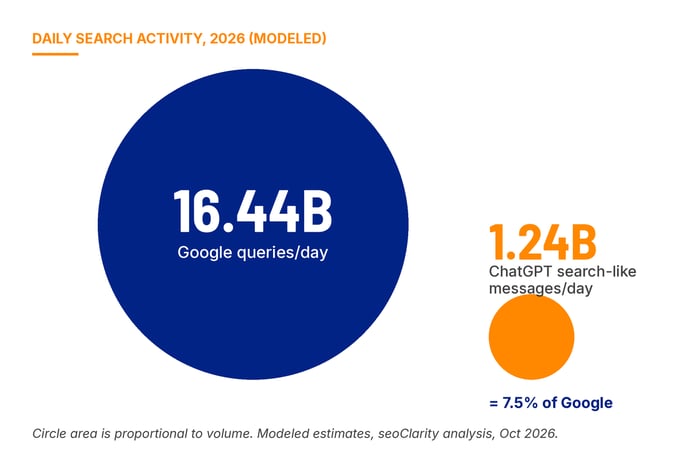 That demand isn’t spread evenly. It shifts by topic and intent, so your Google keyword volumes won’t always tell you how much interest a topic has on ChatGPT. To decide where to invest in AEO, you need a view of AI demand for your own topics.
As of November 2026, our data shows that more than 80% of all searchers now experience an AI-generated response.
For most of your buyers, an AI answer now shapes which brands they consider before they ever reach your site, and that can mean lower traffic without lower demand.
What to do: Track whether your brand appears in AI answers for the topics closest to revenue, and whether those answers are accurate. Then update the pages that should be their source.
Clarity ArcAI shows where your brand appears in AI answers and where those answers misrepresent you, so your team knows what to fix first.
Some industries are feeling the shift to a more AI-driven search landscape more acutely:
If you’re in these spaces, AI search is no longer optional. It’s a primary channel.
Yes, AI search traffic still represents a small fraction of total organic traffic; currently less than 1% across hundreds of client domains. But it’s accelerating year-over-year, and the growth signals are impossible to ignore. Across multiple verticals, we're seeing early signs of adoption, disruption, and shifting user behavior.
Here’s what we’re seeing across real enterprise sites:
Based on our research, CTR for traditional search results is declining sharply as increasingly crowded SERPs (with AI Overviews (AIOs) as a massive factor) push organic results lower.
CTR for Positions 1 and 2 remained relatively stable on desktop during our last CTR study comparing 2024 to 2025:
But CTR for Positions 3–6 has collapsed:
This underscores a critical shift: earning clicks below the top two organic positions is becoming increasingly difficult in AI-first SERPs.
This analysis is based on data from 300+ client analytics accounts, aggregated to identify trends across industries.
Insights are further supported by millions of clickstream queries, providing a detailed view into real search behavior and AI search impact at scale.
AI search visibility insights reflect traffic and behavior across top AI platforms, including OpenAI, Perplexity, Gemini, and Microsoft Copilot, collected between January 2025 and November 2026.
Traffic from platforms like ChatGPT and Perplexity is climbing. CTRs are dropping off sharply below the top positions. And in high-impact industries like education, health, and B2B, AI visibility is already a meaningful share of organic performance.
The takeaway is clear: traditional SEO alone isn’t enough. In a world where brand mentions, citations, and AI-generated summaries influence user decisions, visibility must be redefined.
That’s why we built Clarity ArcAI — the platform designed to help you master both AEO (AI Engine Optimization) and GEO (Generative Engine Optimization).
So you're not just seen in the age of AI search, you're selected.
Not currently an seoClarity client? Learn more about how our platform can help you monitor and strategize for AI search by scheduling a quick demo.

 About the Author: Mitul Gandhi
As a longtime data-driven serial entrepreneur, information architect and SEO veteran, Mitul has developed a blend of vast technical expertise and intense marketing insight. His variety of experience, gained in positions in in-house SEO, search marketing, and software development, affords him the ability to efficiently assess how to use software tools to meet challenges and drive ROI. As the Co-Founder and Chief Architect of seoClarity, Mitul currently oversees day-to-day operations, and provides strategic direction to all departments. His well of knowledge includes 10+ years of consulting experience with Fortune 500 and top Internet retailers concerning online search marketing. He has several patents pending for analyzing cause and effect in SEO. Mitul holds an MBA in direct marketing from Rochester Institute of Technology. Additionally, he has spoken at conferences in the United States and the U.K., including SES, SMX and Pubcon. He has also been quoted in MSN Money, USA Today, Time Online, Search Engine Watch, Search Engine Land and Web Pro News. Connect with him on Twitter or LinkedIn.