



Metrics such as visitors, time spent per session, and conversions have been used for years to steer content creation and marketing campaigns toward success.
The problem is that these traditional analytics only provide half of the story. They don’t explain why content performs well or how specific content influences the journey of marketing qualified leads (MQLs) across multiple touchpoints.
That’s where content scoring comes into play. Creating a scoring system for your marketing content allows you to evaluate quality, discover trends across MQLs, and streamline content creation to meet your goals.
Table of Contents:
- What Is Content Scoring & Why Is It Important?
- 4 Different Ways to Score Content
- What Content Score You Should Aim For?
- Best Practices for Content Scoring
- Frequently Asked Questions
Key Takeaways
- Content scoring turns subjective quality into measurable performance signals. By assigning data-backed scores to relevance, readability, and SEO alignment, teams can make smarter publishing decisions.
- Effective scoring models go beyond keywords. They evaluate funnel impact, topical depth, structure, and search intent to improve both rankings and conversions.
- Content scores guide optimization, not guarantee performance. They provide a benchmark for competitiveness, but must be paired with technical health, authority building, and ongoing refinement.
What Is Content Scoring & Why Is It Important?
Content scoring is a data-driven technique used in search and content strategy to assess the quality and effectiveness of website content. It involves assigning numerical scores to content based on criteria such as relevance, readability, and keyword use.
For search practitioners and data analysts, these scores provide insights into how well their content will perform and help pinpoint areas for improvement.
This data-driven approach also helps optimize content for search engines and ensures that it meets the needs of the target audience. The result? Better visibility in search results, increased engagement, and stronger organic traffic.
Four Practical Ways to Score Content
Every marketing team handles content scoring differently depending on their unique objectives.
When building your comprehensive scoring system, ensure it incorporates important sales data and competitor analysis to fit your end goal.
Below, we will address the four main ways to score content.
1. Scoring Content by Type & Position in the Sales Funnel
The journey of a prospective customer becoming an MQL involves multiple interactions or “touchpoints” with your content, whether it’s reading a blog post, watching a video, or listening to a podcast.
Each touchpoint brings the prospect closer to making a conversion. Therefore, each type of content can be given a score to reflect its value in the journey. A typical score sheet may look like this:
|
Touchpoint |
Content Type |
Score |
|
1 |
Blog Post |
.30 |
|
2 |
Podcast |
.20 |
|
3 |
Infographic |
.20 |
|
4 |
Webinar |
.30 |
In this type of scoring model, it’s become standard practice to place higher value on a prospect's first and last touchpoints. The reason being that the first piece of content caused them to return and the final piece caused them to become a lead.
A single funnel score alone doesn’t create a complete picture. But, as data grows, you can gain actionable insights to shift your strategies moving forward.
Determining an overall score for the content across a buyer’s journey helps you understand which content is more relevant for a first-time visitor versus a qualified prospect. In addition, content scores help identify which pieces of marketing content are not contributing toward conversions.
2. Scoring Content for Readability
With so many aspects of content optimization to consider, one of the easiest to overlook is readability.
Generally, the clearer and more readable the content is, the more time viewers will spend on a page and the better it will perform in search results.
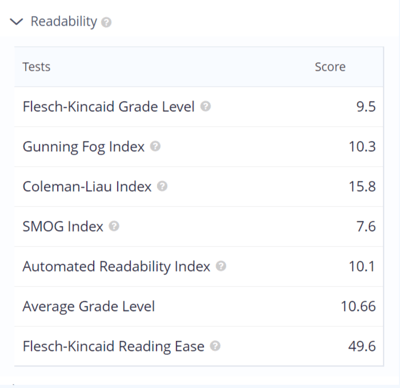
Calculating scores for readability on a given page may include assigning values to:
- Sentence structure
- Vocabulary choices
- Speaking time
- Use of active voice
- Spelling and grammar
Developing a scoring system for readability reveals which pages are ready to publish and which ones have issues that you need to address. These scores also help locate gaps in user accessibility.
3. Scoring Content for SEO
When it comes to optimizing content for search engines and SERP visibility, many marketers create their own guidelines.
Often, marketers base these standards on the best practices of authoritative voices in the industry combined with data they’ve collected over time.
While search algorithms continue to evolve, search engines have been increasingly clear about rewarding content that demonstrates expertise, relevance, and genuine usefulness.
In practice, this means there are clear, observable patterns in what performs well in search results.
Through competitor analysis, you can create an SEO content scoring system that reveals the ranking potential of each page when weighed against what’s currently visible in search results.
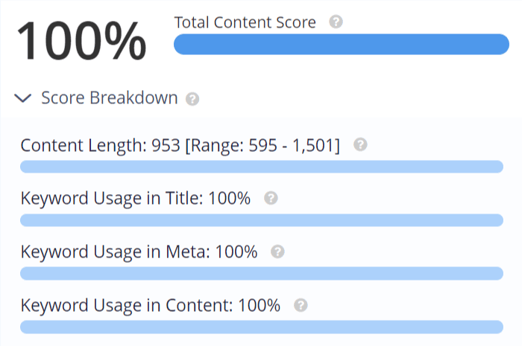
Such a model would assign value to topical coverage, relevance to search intent, contextual keyword usage, clear structure, and supporting on-page elements like titles and meta descriptions. The sum total of these factors serves as your benchmark standard for publication.
But, for enterprise brands looking to simplify and scale their content scoring process, seoClarity offers Content Fusion, an AI SEO content writing tool.
After generating insights on recommended keywords and suggested word count for your topic, Content Fusion provides an overall score for each piece of content that you create.
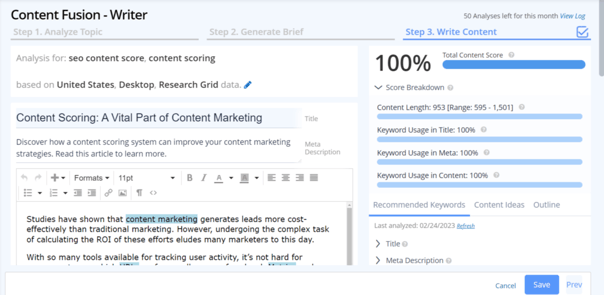
As you build relevance in your content based on the AI-driven insights that Content Fusion provides, the score updates in real-time.
Ultimately, Content Fusion takes the guesswork out of content scoring so that content teams can easily confirm content quality and relevance to a target audience before it’s published on a site.
4. Scoring Content for AEO (AI Search Optimization)
Traditional SEO content scoring helps ensure content ranks. But AI search introduces a new layer of evaluation.
AI-driven engines don’t just rank pages, they extract, synthesize, and cite information. If your content lacks clarity, structured signals, authority markers, or entity alignment, it’s less likely to be included in AI-generated answers.
Scoring content specifically for AI search ensures it is:
- Machine-readable and structurally clear
- Topically comprehensive
- Contextually aligned with user intent
- Structured in a way that supports extraction and summarization
The AI Search Readiness score in ArcAI Content Optimizer evaluates how likely your content is to perform in AI-driven search environments. It measures both how thoroughly your content covers the topic (topical relevance) and how well-structured your content is for AI engines to read the page .
This enables:
- More accurate scoring: Moves beyond high-level topic coverage to assess real optimization quality.
- Deeper content insights: Identifying missing subtopics and entity gaps
- Actionable recommendations: Separating content enhancements from structural improvements
In short, SEO content scoring helps you rank. AI content scoring helps you get cited.
What Content Score Should You Aim For?
When using a content scoring system like Content Fusion, you may wonder what score you should aim for.
While there isn't one universal answer that will apply to every piece of content, we suggest aiming for a score of around 80 or above.
A content score below 70 generally indicates that the piece doesn't include the components needed to outperform competing content.
That being said, it's important not to get too focused on hitting a perfect score. While a content score indicates a piece's relevance relative to the other existing content on the web, a high score does not guarantee that a piece will rank well.
If you achieve a high content score and your page still doesn't rank well, there are several other factors that could contribute to a page's performance. This helpful blog post includes 14 different optimization ideas to increase search visibility such as improving page speed, building authority with topic clusters, and creating a healthy page structure.
Ultimately, content scoring should guide and inform your content creation efforts, rather than act as the sole determiner of content quality.
Best Practices for Content Scoring
To ensure accurate and actionable data, there are a few best practices to keep in mind.
- Define clear goals and metrics for content scoring, aligning them with your overall business objectives.
- Establish a scoring system that takes into account factors like relevance, engagement, and user behavior.
- Regularly review and update your scoring criteria to adapt to changing search algorithms and user preferences.
- Leverage data analysis tools to track and measure the impact of your content on key performance indicators.
Like any other marketing technique, content scoring is an ongoing process that requires review to ensure your system remains effective and sustainable.
Frequently Asked Questions About Content Scoring
Here are some of the most frequent questions we hear from enterprise SEOs regarding the topic of content scoring.
1. Can a content score be "too high"? (The Over-Optimization Trap)
Yes. In the pursuit of a "perfect" score, it is possible to drift into over-optimization. If you are shoehorning every recommended keyword into a 500-word post, you risk a high score but a poor user experience.
The Rule: If your content reads like a list of keywords rather than an authoritative answer, back off. Google’s algorithms are sophisticated enough to detect "keyword stuffing" even if a content scoring tool gives you a 100%. Aim for the "sweet spot" (usually 70-90) where topical coverage feels natural.
2. How do I score "Thin Content" that needs to stay thin?
Not every page needs 2,000 words. A "Contact Us" page or a "Product Specs" table will naturally have lower scores for "topical completeness" because their intent is narrow.
The Strategy: Use custom scoring profiles. Don’t hold a technical spec sheet to the same standard as a pillar blog post. For these pages, prioritize Readability and Technical Readiness over topical depth.
3. How often should I re-score my existing content?
Content decay is real. As competitors publish better data and search intent shifts, your once-85 score might drop to a 60.
The Best Practice: Conduct a "Content Audit" quarterly for your top 10% revenue-driving pages. If a page's search visibility drops, re-run it through Content Fusion to see if new sub-topics have emerged in the SERP that you aren't addressing.
4. Does content scoring work for non-text content like video or interactive tools?
Yes, but the scoring criteria must adapt.
For multimedia assets, scoring can evaluate supporting metadata, transcript optimization, structured data, and search intent alignment. Even interactive tools can be scored based on how well they communicate purpose, authority, and contextual relevance to search engines.
5. What’s the biggest mistake teams make with content scoring?
Treating it as a one-time checklist.
Content scoring is most effective when integrated into workflows, from content briefs to publishing to periodic rescoring. When used reactively instead of systematically, it loses strategic impact.
Conclusion
No matter how you choose to integrate content scoring into your marketing strategy, it’s important to understand the value of these insights for your sales team.
Over time, content scoring will help you understand which steps in the sales funnel are most valuable so that you can strengthen your marketing campaigns in the future!
To improve the performance of their content, marketing teams should consider adopting content scoring as a method to measure content quality, understand their consumers, and increase their ROI.
Simplify and scale this process by using seoClarity's Content Fusion, which offers content scoring, generates detailed content briefs within seconds, analyzes content globally, and leverages content insights via an API.

<<Editor's Note: This post was originally published in March 2023 and has since been updated.>>



Comments
Currently, there are no comments. Be the first to post one!